
Inventory Management
Every bottle on the record. Every pour accounted for.
Vinius models inventory as lots and movements, so you always know what changed, who changed it, and why. From the first purchase to the last pour, nothing disappears without a trace.
The gap today
- POS tracks sales, not what remains by lot or cost basis.
- Spreadsheets lose fidelity the moment two people edit them.
- Over-pours, transfers, and breakage vanish without a trace.
- Wine knowledge lives in one person's head, until they leave.
- Variance investigations consume hours with no clear answer.
What changes with Vinius
- Inventory as lots and movements: every change is dated and attributed.
- Glass-level pour tracking with automatic bottle rollover.
- Cost basis, supplier, and provenance stay attached to every lot.
- Tasting notes and drinking windows live in the system, not in notes.
- Audit trail turns variance from a mystery into a five-minute check.
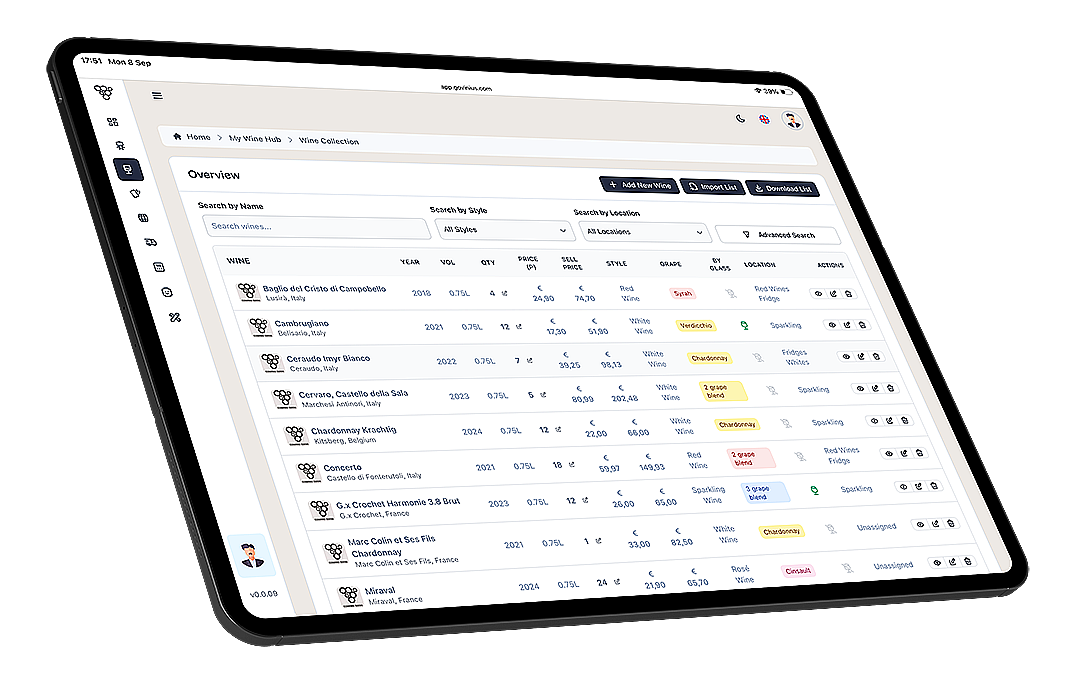
Live lot-level inventory with full movement history
What's inside
Built for the way wine programs actually work
Not a stock counter bolted onto a list editor. Every capability connects back to the same lot-based data model.
Glass-level pour tracking
Record every pour with volume precision. Bottle rollover is automatic when a bottle empties, so counts stay accurate without manual correction.
Lot-based inventory
Each purchase batch is its own lot with its own cost, supplier, and depletion sequence. Multiple lots of the same wine stay distinct throughout their life.
Full movement history
Every purchase, transfer, pour, and adjustment is logged with who made the change and when. Variance investigations take minutes, not hours.
Structured wine data
Masters, vintages, regions, appellations, and grapes in one normalised data model. Clean, consistent, and ready to power pricing, cards, and reordering.
Tasting notes and drinking windows
Layer sommelier expertise and drinking-window guidance onto inventory records. Available throughout the program, from the cellar to the guest-facing wine card.
Audit trail and attribution
Full tracking of who created and updated every record. Supports team accountability and provides the evidence trail any serious wine program needs.
How it works
From first purchase to last pour
Purchase creates a lot
Supplier, date, unit cost, and storage location attach from day one. Multiple vintages from the same producer stay distinct.
Every movement updates the record
Pours, transfers, adjustments, and sales log as they happen. Bottle counts stay accurate without end-of-week reconciliation guesswork.
The audit trail never resets
Any change by any team member is timestamped and attributed. If stock does not add up, you can trace exactly where it went.
Valuation follows from the data
Purchase cost, selling price, and market-value context live in the same record. Owners see what the program is worth, not just what exists.
For serious collectors too
A cellar managed like a portfolio
The same lot-based foundations that run a restaurant wine program apply directly to a private cellar. Lot records keep provenance and purchase cost intact. Valuation visibility shows what the collection is worth. Drinking-window tracking surfaces what is ready now versus what needs time.
- Multi-location storage with active-site context
- Lot-level cost basis and market valuation
- Drinking windows and peak-window tracking
- Movement history for every bottle in the collection
What it changes
Operational outcomes
Industry-typical figures. Actual results depend on the program.
Outcomes & Metrics
| Outcome | Before | With Vinius |
|---|---|---|
| Unexplained stock loss | 5-12% is industry-typical | Targetable once movements are tracked |
| Inventory reconciliation time | Hours per week manually | Event-driven, near real-time |
| Data consistency | Fragmented across POS, spreadsheets, notes | Single lot-based source of truth |
| Staff onboarding on wine program | Weeks; knowledge is person-held | Faster: context is in the system, not in someone's head |
Unexplained stock loss
- Before
- 5-12% is industry-typical
- With Vinius
- Targetable once movements are tracked
Inventory reconciliation time
- Before
- Hours per week manually
- With Vinius
- Event-driven, near real-time
Data consistency
- Before
- Fragmented across POS, spreadsheets, notes
- With Vinius
- Single lot-based source of truth
Staff onboarding on wine program
- Before
- Weeks; knowledge is person-held
- With Vinius
- Faster: context is in the system, not in someone's head
Every bottle accounted for.
Track lots, movements, and pours in one system of record. Request access, accepted by invitation.