
AI Enrichment
Wine data that gets better the more you use it.
Governed AI enriches wine content, regions, pairings, and translations with a human review layer built in. High-confidence suggestions apply automatically; uncertain ones route to a review queue. Data quality improves over time.

The gap today
- Adding a new wine means manually researching region hierarchy, appellation spelling, and grape details.
- Inconsistent naming creates duplicate regions and breaks taxonomy across the catalogue.
- Staff skip enrichment when it takes too long, leaving records sparse.
- Tasting notes and pairing guidance are inconsistent or absent for most of the list.
- AI tools used outside the system create a pile of unverified text that gets copy-pasted in.
What changes with Vinius
- When a wine is added, AI generates region hierarchy, structured codes, and pairing guidance immediately.
- High-confidence results auto-apply; uncertain items route to a review queue for human sign-off.
- Consistent normalisation prevents duplicate appellations and naming drift across the catalogue.
- Enrichment happens within the workflow, not as a separate research task.
- A human reviewer stays in the loop for anything the model is not confident about.
What's inside
Enrichment with human oversight at every step
Every capability is designed to make the sommelier's judgment more effective, not to replace it.
Region hierarchy generation
Produces a complete country, region, subregion, and appellation chain from a wine name. Punctuation and code formatting applied consistently.
Confidence scoring and review
High-confidence results apply automatically. Items below the threshold route to an admin review queue rather than being applied unchecked.
Consistent normalisation
Names, codes, and accents follow a single standard across the catalogue, preventing the duplicate-region problem common in manually maintained systems.
Tasting notes and pairings
AI drafts structured tasting notes and food pairing suggestions as part of the enrichment flow, ready for sommelier review before use on wine cards.
Translation support
Wine descriptions and tasting notes can be enriched in multiple languages, supporting international operations and guest-facing content in local languages.
Human oversight by design
Enrichment runs through a validation layer, not direct writes. Human review is not optional; it is built into the workflow for anything the model flags as uncertain.
How it works
From new wine to enriched record
Add a wine to inventory
When a new wine is added, the enrichment pipeline runs immediately. Region data, normalised codes, and pairing guidance are generated in the background.
High-confidence results apply
Where the model is confident, results apply automatically with no friction. The sommelier's time is reserved for decisions that actually require judgment.
Uncertain items enter the review queue
Anything below the confidence threshold waits in a queue. A reviewer sees the suggestion alongside the source data and approves or corrects it.
Corrections improve future results
Validated corrections feed back into the normalisation layer, making the system more accurate for similar wines added in future.
Region data in practice
One wine name becomes a complete hierarchy
A sommelier types "Gevrey-Chambertin". The enrichment pipeline returns France, Burgundy, Côte de Nuits, Gevrey-Chambertin as a structured four-level hierarchy with ISO codes and canonical appellation spelling. That same structure powers the wine card, the filtering layer, and the reporting views, without anyone maintaining it manually.
- Country, region, subregion, and appellation as structured fields, not free text
- Canonical spelling and accents applied consistently across all records
- The hierarchy powers wine card grouping, list filtering, and analytics
- Duplicate appellations surface as warnings during the review step
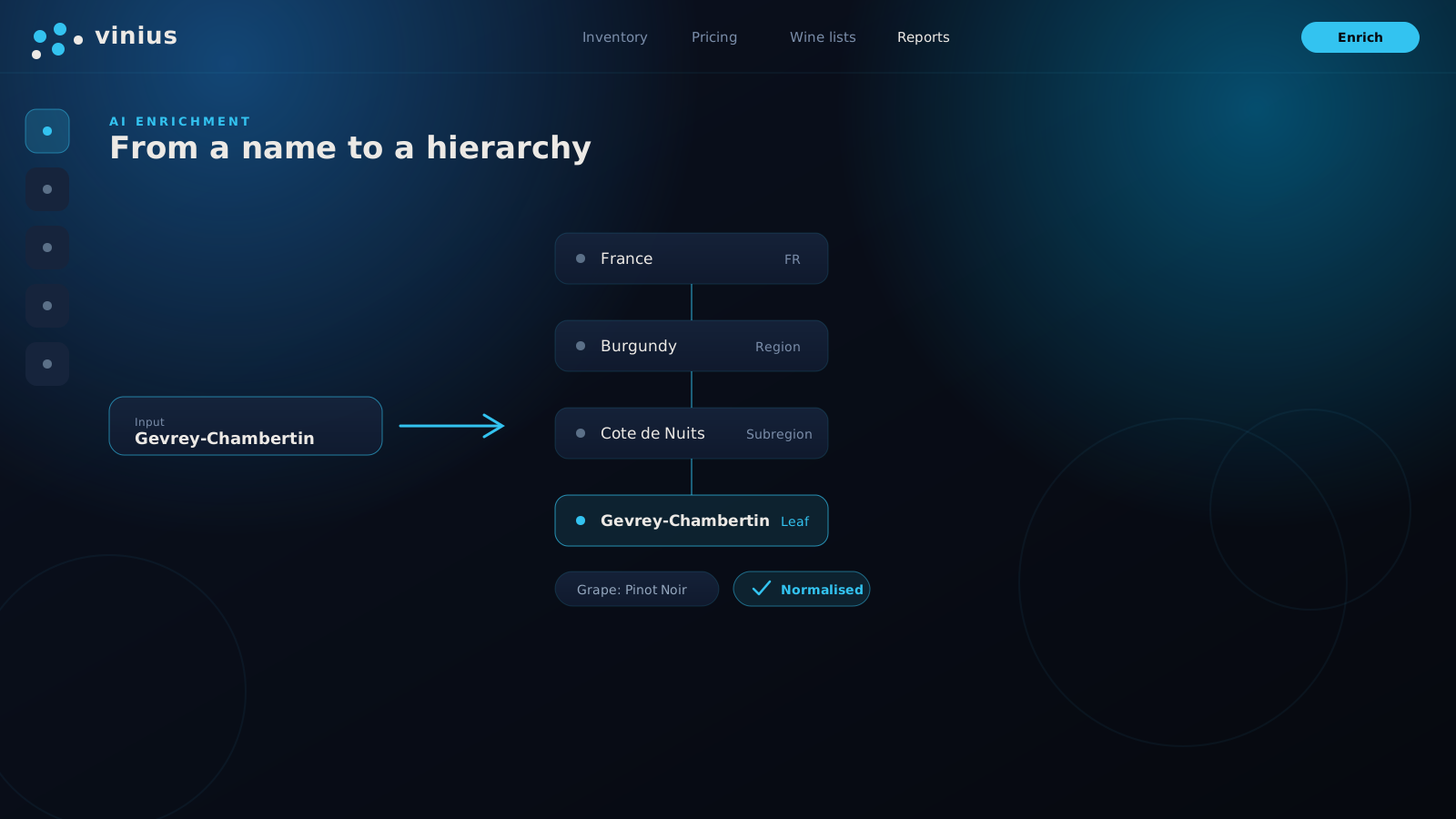
From a single wine name to a complete, normalised region hierarchy
What it changes
Operational outcomes
Industry-typical figures. Actual results depend on the program.
Outcomes & Metrics
| Outcome | Before | With Vinius |
|---|---|---|
| Time to enrich a new wine | Manual research across multiple reference sources | Seconds with AI suggestions; minutes including human review |
| Region duplicate rate | Common in manually maintained catalogues due to spelling variation | Substantially reduced through normalisation |
| Tasting note coverage | Patchy; depends on staff effort and time | Generated at the point of adding a wine, reviewed before use |
| Data quality over time | Tends to degrade as the catalogue grows | Improves as corrections feed back into the normalisation layer |
Time to enrich a new wine
- Before
- Manual research across multiple reference sources
- With Vinius
- Seconds with AI suggestions; minutes including human review
Region duplicate rate
- Before
- Common in manually maintained catalogues due to spelling variation
- With Vinius
- Substantially reduced through normalisation
Tasting note coverage
- Before
- Patchy; depends on staff effort and time
- With Vinius
- Generated at the point of adding a wine, reviewed before use
Data quality over time
- Before
- Tends to degrade as the catalogue grows
- With Vinius
- Improves as corrections feed back into the normalisation layer
Data quality that improves over time.
Enrich wine records, regions, and content with governed AI. Request access, accepted by invitation.